Even the Balinese temple, it has been noted, is surrounded by a stone wall dividing its sacred precincts from the village very much like Hawaiian and Tahitian places of worship.
BALI ANJANI VACATIONS provides accommodations, hotels, villas, Tour Packages and General Information for your holiday in Bali and Beyond
BALI ANJANI VACATIONS provides accommodations, hotels, villas, Tour Packages and General Information for your holiday in Bali and Beyond

Balinese temples are wonderful places. Typically divided into three parts, one inevitably passes through a split gate or Candi Bentar to enter the first courtyard. Here a second gate rising high with the grinning face of a guardian demon leads to the second division. Inside there are numerous pavilions used for various purposes. In the final courtyard one may find the meru pagoda which may have as many as eleven roofs if the owner or temple is important enough.
The black thatch is from the sugar palm and can only be used in temples. There will also stand numerous sanggah or spirit houses and pedestals which will be full of offerings on ritual days. Everywhere carving in brick, volcanic stone and wood will be apparent. All are ringed by walls.
The Balinese have always spent a great deal of energy and money on their temples for it is the duty to repay the ancestors for the prosperity they have brought for their progeny.
Balinese royalty has always felt it imperative that they demonstrate their prosperity and standing by building magnificent palaces also surrounded by thick walls of brick and stone. The carved wooden doors of these palaces are especially famous of their beauty.
The teak doors of the main palace of Denpasar were so large that they required forty porters to drag them from the capital 7 kilometers to Sanur beach. In the palaces bright colors and gold leaf abound for the display of opulence in even the smallest and most insignificant of details is deemed proof of nobility.
Unlike Europe, Balinese palaces are not single huge buildings but rather a collection of numerous structures each with a special function such as the bale gede, an open pavilion of 12 columns, where the oldest male of the family sleeps.
During important ceremonies - like tooth filing - this will serve as a place to commune with the ancestors and gods who descend from the heavens to partake of the many offerings placed on the beds. As in the temple the four directions of the Balinese compass are critical in determining the lay-out and positioning of buildings.
There is a developed Balinese science of geomancy written in the ancient paling leaf manuscripts. This is known as Kosala-kosali. Through it we can determine the best place to locate a kitchen for instance. Oftentimes when a family is suffering bad luck or misfortune, the first place the balian or witch doctor will look for is any unwitting violations of the Balinese laws of building. The science of building is held to be a sacred knowledge and traditional Balinese architects who might also be rice farmers were known by the distinguished title of undagi.
Another large and important structure is the wantilan or so called cock fighting arena. It is called this because at one time cock fights were frequently held here. It is found near the palace and central market in every traditional village. Nearby stands a kul-kul or slit drum tower to call the members of the village together for meetings. The wantilan is also commonly used for performances. Once built entirely of wood most are made of re-enforced concrete today. The traditional wantilan has also inspired the shapes and forms of many hotels and houses such as the Amandari.
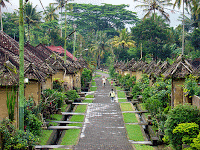
Aside from the rich ornamentation of the temples and palaces, the everyday structures of the average Balinese are as beautiful and elegant as any. Using such natural materials as thatch roofing, bamboo poles, woven bamboo, coconut wood, mud and stone they are organic statements in complete harmony with the environment. Many of these are temporary such as the offering houses set up before harvest in the rice fields.
Others use trees that will actually keep on growing as the bamboo rots and returns to the mother earth. The Balinese have always been particularly adept using the bamboo and behind every Balinese house one can find at least one stand of bamboo.
The introduction of cement and other modern materials and the rapid growth of hotels, galleries and new homes have produced mixed results. The opulence and ornamentation of many new hotels are often breath taking. Nowhere else in the world would such wood carvings and stone work be possible. Still the line between kitsch and a good taste is narrow and too often people have failed to appreciate the essence of Balinese architecture that in many cases has become an amazing parody of itself. One hopes that in the future more attention will be paid to resorts like the Amandari and Four Seasons Resort in Jimbaran, who have modified traditional Balinese architecture without tainting its integrity.
For those wishing to build their fantasy home in Bali - the opportunity to create a residence that you could never afford elsewhere is very attractive. Remember though that it is not as simple as it may seem.
If you have love, dedication and a great deal of patience though you might find your lovely new home on the cover of House and Garden or Architectural Digest in the near future. For those truly interested in Balinese architecture, a visit to the Bali Museum in Denpasar is a must. There you will not only find many old traditional buildings but also information as to the local styles, of which there are many. Also if you would like to take a piece of tradition back with you there are numerous traditional rice barns, the original knock down building, available for sale for extremely reasonable prices.
More Info :
Program to visit Bali traditional house : Full Day Kintamani Tour
Program to visit Bali traditional house : Half Day Ubud Tour
Program to visit Bali traditional house : Tour Around Bali Package
Place of Interest to visit Bali
More Info :
Program to visit Bali traditional house : Full Day Kintamani Tour
Program to visit Bali traditional house : Half Day Ubud Tour
Program to visit Bali traditional house : Tour Around Bali Package
Place of Interest to visit Bali
Source:
http://www.bali-thepages.com/architecture.shtml
Tweet Continue to read...