Pura Goa Lawah or Bat Cave Temple lies just three km northeast of Kusamba harbor and 9 km east of Klungkung on the left side of dramatic road paralleling the sea with uninterrupted views of sea and Nusa Penida.
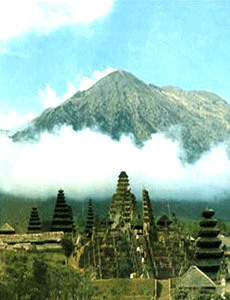
As its name suggests Pura Goa Lawah houses a holy cave begins at the foot of rocky cliff and is said to extend all the way to the base of Mount Agung.
BALI ANJANI VACATIONS provides accommodations, hotels, villas, Tour Packages and General Information for your holiday in Bali and Beyond
Oral tradition says the cave leads to Pura Goa (cave temple) within the Besakih temple complex some 30 km away. A tale is told how a prince of Mengwi actually entered the sacred cave to prove that he was the rightful descendent of Mengwi King, and emerged at Besakih, but his feat was never duplicated – entering the cave is now forbidden.
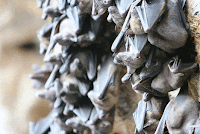
The ceiling is alive with thousands of fluttering, squawking, vibrating, long nose fruit bats. The wheeling, squealing bats are drawn again and again into the deep and dusky cavern; the noise is deafening but the sight is awesome. A thick layer of slippery, sickly sweet bat droppings carpets the cave floor, through which bat-gorged pythons ooze in a state of surfeit. Lizards are crawling free in this cave and temple completely ignored by the passing pilgrims and visitors.
Bat excrements also cover the majestically black shrines of Pura Goa Lawah guarding the cave entrance.
This sacred temple was founded in 1007 by the holy Sage from Java, Mpu Kuturan. The temple is one of Sad Kahyangan (six great temples of Bali).
The temple and the cave is an obligatory site of Nyekah (deification of the deceased family member soul) pilgrimage. Balinese believe the cave harbors an enormous dragon, Naga Basuki, the mythical serpent of universe and the caretaker of the earth’s equilibrium.
Goa Gajah the holy elephant cave is located in west side of Bedulu countryside, Blah Batuh Sub-district and Gianyar Regency. It is about 27 km from Denpasar town.
This cave is built at crevasse edge from the federation of 2 rills that is called Pangkung River, where the irrigation is mixed with Petanu River flow. The federation area of two rivers is called Campuhan. It owns the magical energy on the basis of Rwabineda concept (two different matters) on this basic concept hence Goa Gajah (elephant cave) is intentionally built among two rivers.
BALI ANJANI VACATIONS provides accommodations, hotels, villas, Tour Packages and General Information for your holiday in Bali and Beyond
At the facade of the cave is a relief of various menacing creatures and demons carved right into the rock at the cave entrance. The primary figure was once thought to be an elephant, hence the nickname Elephant Cave. The site is mentioned in the Javanese poem Desawarnana written in 1365. An extensive bathing place on the site was not excavated until the 1950s. These appear to have been built to ward off evil spirits.
The word of Goa Gajah is anticipated coming from the word of Lwa Gajah, the name of Buddhist Temple or hermitage for Buddhist monk. The Goa Gajah's name is written on Negara Kertagama papyrus which is compiled by Mpu Prapanca on 1365 M.
Lwa or Lwah/loh means the river, and it reflect to the meaning that the hermitage is located at Gajah River or in Air Gajah.
In the year inscription 944 Saka, it is mentioned with the name of ‘ser ring Air Gajah' that is meaning the Subak leader in Air Gajah. The word has mentioned that the hermitage of Lwa Gajah is located in Subak Air Gajah.
There is a relief which is almost looking like the form of mountain on the entrance of this cave. It was carved many designed on the relief like grove with the stick, close leaf, animal for example forest pig, tortoise and specters.
The cave mouth is decorated by the bas-relief with the eye turn around to the right or west side.
There is an article letter of Kediri type from the early of 11 century was written on the wall left side or east side.
There is a pool (Patirthaan) as a place to take the holy Tirtha water for Hindu ceremony which is located in the middle of the cave courtyard. This Holy Pool is previously piled up by land and it has been found on 1954 by Krijgsman from the Ancient Department. The Holy pool is equipped by the statue douche which is parallel arranged in two groups.
This site was added to the UNESCO World Heritage Tentative List on October 19, 1995 in the Cultural category.
Alas Kedaton is a small forest with the width about 6-7 ha, located in the middle of the rice field in Kukuh countryside, Marga Sub-district, Tabanan Regency, west part of Bali.
The total size of this forest, temple and its supporter facility is about 12 ha.
On the way go to this tourist place, we will see the beautiful nature view where in front of us will meet the carpet of rice field and irrigation voice at the side of road to bear the impression/peaceful atmosphere.
BALI ANJANI VACATIONS provides accommodations, hotels, villas, Tour Packages and General Information for your holiday in Bali and Beyond
In this forest, there is a temple called Alas Kedaton Temple and owns the natural environments that is looked green with its fresh air and create the calm, quite and holy atmosphere.
Alas Kedaton Temple have three yard that are external yard, middle and center yard. In the center and middle yard are encircled by wall and the outside yard is representing a open yard. The interesting point of this temple is the inside yard representing holy yard, its situation lower than the middle yard.
This thing is different compare with the general temples in Bali that are more goes to inside the temple, the more higher the place will be. Beside of that another interesting point of this temple owns four entrances.
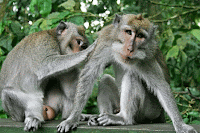
The monkeys in Alas Kedaton are very tame and free gallivanting in temple yard, so that the calm atmosphere is sometime solved by noise voice of the monkey, which are playing around and scrambling of food.
The monkeys who dwell in this forest, there are jump up and down in temple wall, take a bath in moat or there is also hang out in few leaves representing impression view. The monkey like as custodian of temple, which are always ready to greet all visitor who are paying a visit to this place.
Beside monkeys, in Kedaton forest also can be met the bats and some other animals. At least 24 types of grove plant have been identified in Alas Kedaton.
The temple ceremony in alas Kedaton temple is carried out every 210 days a year. It is on AnggarakasihMedangsia (Balinese Hindu Calendar) or on every Tuesday where on that time the society do the worship or pray to request the safety and prosperity.
The unique in this ceremony is do not use the fire and do not hence Penjor and also finished before the sunset or before the night is come.
In growth of handling of this tourist destination, Alas Kedaton has several become a training location about tourism nature, environmental handling and agro tourism. Alas Kedaton is many visited by the tourist from local and foreign countries which are generally a lot of paying a visit on August, December until January, while the local tourist generally pay a visit on holiday season and feast day of Ramadan (Moslem holiday) and this place is good to be visited in the day time.
In front of Alas Kedaton temple there are quite a lot small shops selling the handicraft as souvenir, for example clothes, pants and other handicrafts. Others, there are some shops booth selling food and beverage, toilet and park area which is wide enough.
The Ulun Danu Beratan Temple is located in Bedugul, 90 minutes drive from Denpasar. Backed by the enfolding green hills and the cold green waters of Lake Beratan, its charm enthralls visitors and attracts people from all over the world. The temple is one of the most prominent icons of Bali.
BALI ANJANI VACATIONS provides accommodations, hotels, villas, Tour Packages and General Information for your lovely holiday in Bali and Beyond
The history of the temple goes back to the era when I Gusti Agung Putu established the Mengwi Kingdom. He built the Ulun Danu Beratan as a shrine for the God praised in the Puncak Mangu Temple. The inscription of Babad Mengwi, dated back in 1556 Çaka year, tells that I Gusti Agung Putu was defeated by another knight, and was given to I Gusti Ngurah Tabanan as a hostage.
Later on the defeated knight wanted to restore his power and holiness, and had he gone to Puncak Mangu to meditate and he was blessed with the magical power of a knight as a result.
The Ulun Danu temple consists of four complexes: the one at the eastern part is Lingga Petak shrine. The shrine has four doors facing the four wind directions. It is said that in the foundation of the shrine three huge stones where uncovered: white, red, and the smallest is black. There is a spring under the white stone, and it was decided that the shrine should be dedicated to the God of Ulun Danu Beratan.
The second complex is on the west of Lingga Petak Shrine, the compound called Pesimpangan Puncak Mangu. Puncak Mangu is considered as the symbol of fertility of the soil. So in this shrine, the God of Fertility and Prosperity is praised. The biggest complex in the temple compound is Pesimpangan Pura Terate Bang. The main shrine has seven storeys, where the God as creator of the earth and life is praised. One shrine in the complex is especially dedicated for the ancestors of the king Mengwi. Last but not least, The Goddess Uma, the wife of Shiva, can be praised in the Terate Bang complex. The Goddess is considered as the source of happiness.
The Ulun Danu Temple has a very calm atmosphere. The cool climate of Candi Kuning gives an extra touch to the ambience. The locals come to the temple not only for praying, since there is a wooden bridge at one corner of the compound where you can sit back and relax while the cold water of the Lake Beratan chills your tired legs. The lush green garden at the main entrance is also wonderful. You can really expect a delightful hassle-free visit to a temple that is known as one of the most famous temples of Bali.
Put this temple on your destination list when you come to Bali.
A lontar manuscript indicates that in 158AD Rsi Markandiya came to an island with a mountain range from east to west, which was visible from his meditation spot at the summit of Mount Rawung, East Java. Rsi Markandiya was a yogi from India who had meditated in East Java for many years – exactly how many, is unknown. While he was meditating, a supernatural voice told him to go to the island together with his people.
BALI ANJANI VACATIONS provides accommodations, hotels, villas, Tour Packages and General Information for your lovely holiday in Bali and Beyond
A tragic incident occurred while he and his people were on the island named Pulau Dawa; Pulau means island and Dawa means long. They worked hard to prepare the land for cultivation. Unfortunately, some wild animals and a strange epidemic killed many of his people. The tragedy caused great despair to the Maha Yogi, who returned to Mount Rawung and only revisited Pulau Dawa some years later.
When Rsi Markandiya returned to Pulau Dawa, he brought with him a group of people from the village of Aga in Mount Rawung. Before they started the hard land work, several rituals were held, and Rsi Markandiya performed a special ritual called Panca Datu. This ritual incorporated 5 elements… namely gold, silver, and bronze, a metal material (like tin or iron) and a red diamond. Rsi Markandiya named the site of the ritual as Basuki, which means 'Bless'. Nowadays, the area is popularly known as Besakih.
The people of Aga are now known as the Bali Aga; Bali from the word Wali means holy sacrifice and Aga means mountain. Rsi Markandiya organized his people and taught them farming, and introduced a structured social system. Thus, the island civilization of Bali started at a sacred place in the foot of Mount Agung, where a temple complex still stands majestically to this day.
Besakih temple is an extensive complex with 23 temples. The largest temple inside the complex is Pura Penataran Agung which is dedicated to Shiva. Other temples include Pura Kiduling Kreteg, representing Brahma, the Creator; and Pura Batu Madeg, representing Wisnu, the Preserver.
These three manifestations of God are known as Tri Murti. Besides these temples, there are also temples representing Panca Dewata; 5 Godly manifestations that protect the centre of the complex and the 4 directions radiating north, south, east & west of the centre. On the right and left side of Pura Penataran Agung, there are clusters of temples called pedarman where people come to pray and give offerings to their ancestors.
The complex is vast and hilly, so it is advisable to get a guide who is capable and has a good knowledge of the temple complex; otherwise you'll have to do the best you can on your own with a brochure and guide map. Indeed, there many things one can observe and appreciate in the temple complex. For example, one can appreciate the magnificent carvings which tell some epic stories of the Ramayana and Mahabrata dynasties. These decorative carvings form a part of the temple's traditional architecture, along with and Kamasan style paintings which are very ancient. Please note that tourists are not allowed inside the temples.
The best time to visit Besakih is in the morning or late evening. The breeze, the quiet environment, and the superb view down to the coast – particularly when there is no mist, add so much to the ambience of the complex. Besides, during these times of the day, not so many people are in the temple complex, and the crowds of people who call themselves temple guardians – and usually convince tourists to go around under their guidance – are not yet roaming around the complex, so one may have a hassle-free tour.
The temple which is located in Klungkung Regency is a unique heritage for all Balinese people; and indeed, Besakih has its own unique charm. It is believed that the temple area is surrounded with mystical supernatural powers. In 1963, when Mount Agung erupted, Besakih was the only place to survive from the lava explosion, even though it is nestled on the foot of the mountain. It is every Balinese's dream to pay homage to the Gods of Besakih, and the temple has a very important role in the history of Balinese civilization.
Taman Ayun Royal Temple is located at Mengwi, about 18 km north side from Denpasar City. As a Royal Temple of Mengwi Empire, Taman Ayun is one of recommended place to visit when you come to Bali.
BALI ANJANI VACATIONS provides accommodations, hotels, villas, Tour Packages and General Information for your lovely holiday in Bali and Beyond
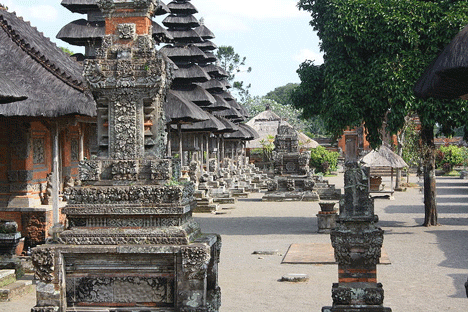
The temple strategically located beside of major roadway between Denpasar to Singaraja Regency, set on the land which is surrounded by the big fish pond and look like a drift on the water. Build with multistoried roof and Balinese Architecture. The wide beautiful landscape garden in front courtyard to welcome all visitors who come and visit this temple.
History
Pursuant to Lontar Babad Mengwi (Papyrus Chronicle of the Mengwi), the temple which is now referred by Pura Taman Ayun had been newly sanctified in the year 1634 M and it is named with Taman Ahyun Temple. The word of Ahyun is coming from the root word Hyun meaning a temple is founded in the park (pool with the beautiful garden) which can fulfill the desire. The word Ahyun is then changed into Ayun word. Taman Ayun Temple is one of Hindu Temples in Bali become tourist destination which has been visited by many tourists from local and foreign. This temple is usually visited by tourist once having a set tour to Tanah Lot Temple due to this temple is the same route of the Tanah Lot Tour.
Function
The function of Taman Ayun Temple is a place to pray the god in their manifestation. It is according to the content of Babad Mengwi and the existence of temple building structure, especially the temple that is located in third area (Jeroan). According to Astadewata, the special God is worshiped in Taman Ayun Temple is the God in manifestation as a Wisnu God which his palace located in top of Mount Mangu. In papyrus of Usana Bali mentioning that one of Dewa Catur Lokapalas carry through its worship is Meru Pucak Pangelengan that is a temple building with 9 multistoried roofs.
Pitara God is a holy soul deity of ancestor who is also referred as the other names of Hyang Pitara or Dewa Hyang. Pitara God is obliged to be worshiped by clan heir (Prati Sentana) in the form of temple ceremony which the same meaning as by the ceremony to the god. The worshiping existence to Pitara God in Taman Ayun Temple can be searched and proved by pursuant to the existence of temple building which lay in by consecution in east which is called Paibon that is representing Special Temple. Taman Ayun Temple in capacities or its status as special altar for the King family of Mengwi Palace or as a Merajan Agung from Mengwi King Families specially for the founder of Mengwi Empire that is I Gusti Agung Putu.
Pura Sebatu or Sebatu Temple located around 40 kilometers from Denpasar, built in homage to the God of preserver – Wisnu - who rules over water, and here one finds a number of natural spring and waterspouts.
BALI ANJANI VACATIONS provides accommodations, hotels, villas, Tour Packages and General Information for your lovely holiday in Bali and Beyond
The Balinese believe that water is one of the forces of life. The etymology of Gunung Kawi means a fabricated mountain. It lies west of Sebatu village, which is elevated and its name means slipping on a stone.
It is said in the times of King Mayadenawa - an evil King who did not believe in the existence of the God - which this area was where he chased with his soldiers by the Gods in a famous battle. At first he battled with the Gods at the great Besakih temple and then came to Sebatu via the village of Taro. Both the soldiers of Mayadenawa as well as the local villagers fled in their fear (the former of the gods, the latter of the evil King) and slipped on stones.
Seeing that local people were innocent and sin free, the God Wisnu gave a source of life (holy water). As a way of showing their gratitude, they built this temple to the Wisnu's God, which has much water, waterspout for bathing as well as a special pool of holy spring water.
A natural spring flows from the heart of the temple into a pool so clear that you can count the scales on the huge goldfish ghosting around the opulent island shrine at its center. Holy water is requested at an adjacent small shrine while nearby, and still within the temple walls, are the open-air public baths.
The visitors are welcome to explore the other courtyards where the shrines and pavilions are lovingly maintained by the people of nearby Sebatu.
Tanah Lot is claimed to be the work of the 15th century priest Nirartha. During his travels along the south coast he saw the rock-island's beautiful setting and rested there.
Some fishermen saw him, and bought him gifts. Nirartha then spent the night on the little island. Later he spoke to the fishermen and told them to build a shrine on the rock for he felt it to be a holy place to worship the Balinese sea gods.
BALI ANJANI VACATIONS provides accommodations, hotels, villas, Tour Packages and General Informations for your lovely holiday in Bali and Beyond
The Tanah Lot temple was built and has been a part of Balinese mythology for centuries. The temple is one of seven sea temples around the Balinese coast. Each of the sea temples were established within eyesight of the next to form a chain along the south-western coast.
At the base of the rocky island, poisonous sea snakes are believed to guard the temple from evil spirits and intruders. A giant snake purportedly protects the temple, which was created from Niratha’s scarf when he established the island.
In 1980 the temple’s rock face was starting to crumble and the area around and inside the temple started to become dangerous. The Japanese government then provided a loan to the Indonesia government of Rp 800 billion (approximately USD $130 million) to conserve the historic temple and other significant locations around Bali. As a result, over one third of Tanah Lot's "rock" is actually cleverly disguised artificial rock created during the Japanese-funded and supervised renovation and stabilization program. (http://en.wikipedia.org/wiki/Tanah_Lot)
On Tanah Lot temple area you can also find some other temples ;
Penataran Temple
Penataran Temple is one among of several temples in Tanah Lot area. It is located in the north of Tanah Lot Temple. Penataran Temple is a place to pray for God and his manifestation in Tanah Lot Temple for wellness and happyness. The Ceremony of Penataran Temple has two ceremony days, the first day is same as Tanah Lot Temple which is held every 210 days on “Rebo Wage, Wara Langkir”, and the second day is on “Rebo Wage, Wara Merakih” according to the Balinese calendar.
Penyawang Temple
Penyawang Temple is located in the west side of Penataran Temple. This temple was built for all prayers to pray for God and the manifestation who take place and has authority in Tanah Lot Temple as God of the ocean. If the water of the sea was tide, Hindus people cannot pray into the Tanah Lot Temple but they can pray at Penyawang Temple.
Jero Kandang Temple
Jero Kandang Temple is located about 100 meters in the west side of Penyawang Temple. Jero Kandang Temple was built for villagers of Beraban village to require the wellness for their animals and plants from disease. The name of Jero Kandang Temple was took from the function that is put into a stable (kandang) all the disease. Based on the function, Jero Kandang Temple is a place to pray for God with the manifestation as the God of all animals and plants, also pray for Dewi Sri as manifestation of God as the Goddess of prosperity.The Ceremony of Jero Kandang Temple is every Sabtu (Saturday) Kliwon, Wara Uye or Tumpek Kandang day according to Balinese calendar.
Enjung Galuh Temple
Enjung Galuh Temple is located near Jero Kandang Temple to be exact at Enjung Galuh, “njung” wich is rock stick out in to the sea. Enjung Galuh Temple was built to pray for the Goddess of prosperity Dewi Sri as the power (Shakti) of Dewa Wisnu (God Manifestation as The Protector). The villagers pray requiring the fertility of the plants and rice-plant for the achievement of the prosperity in their life. The Ceremony of Enjung Galuh Temple is every Rabu (Wednesday) Umanis, Wara Medangsia according to Balinese calendar.
Batu Bolong Temple
Batu Bolong Temple is located 100 meters in the west side of Enjung Galuh Temple, to be exact at Enjung Batu Bolong, which is the rock that stick out in to the sea was hollow (bolong). Batu Bolong Temple was built to pray God for holiness. Enjung Batu Bolong area is a place that always used to held Melasti Ceremony and Pakelem Ceremony, where the meaning of both Ceremonies is to purify the world. The Ceremony of Batu Bolong Temple is every Rabu (Wednesday) Wage, Wara Langkir according to the Balinese calendar.
Batu Mejan Temple
Batu Mejan Temple is located 100 meters in the west side of Batu Bolong Temple. Batu Mejan Temple also known as Beji Temple, “beji” means holly place to get holly water for Hindus ceremonial. Batu Mejan Temple was built for villagers to beg a mercy from God trough holly water.In the south of Batu Mejan Temple along the beach, there was spring water and we could find it clearly when the sea water was decrease. Hindus people believe that spring water was holly water (tirtha pangelukatan) that could be use to purify all the badness.The Ceremony of Batu Mejan Temple is every Sabtu (Saturday) Kliwon, Wara Kuningan or Kuningan Day according to the Balinese calendar.
Pakendungan Temple
Pakendungan Temple is located in west side in Tanah Lot Area it is just 300 meters from Tanah Lot Temple. It was built in year Çaka 1330 to be exact in year 1408. Pakendungan Temple has one unity with Tanah Lot Temple. When Dang Hyang Nirartha continue his journey to find the Holy Light in Segara (Sea) Kidul Tanah Lot, he was do meditation (yoga semadi) in luxuriant forest in the west side of Segara (sea) Kidul Tanah Lot to get some vision of God about the Holy light. The forest name was known as Kendung Forest. The place that used by Dang Hyang Nirartha meditate, was built a temple and known as Pakendungan Temple. Pakendungan temple is place where Keris sakti (Holy Keris) “Ki Baru Gajah” that had power to subjugate all the disease plants in Bali Island was kept. Keris Ki Baru Gajah was holy keris given by Dang Hyang Nirartha to the Chief of Beraban Village before He leave the Beraban village. This ancient Ki Baru Gajah was kept in Puri Kediri and its Ceremonial is same with Pakendungan Temple Ceremonial is every 210 days in Sabtu (Saturday) Kliwon, Wara Kuningan or Kuningan Day, according Balinese calendar.
Tri Antaka Monument
Since March 1946, the NICA (Netherlands Indies Civil Administration) had already full power in Tabanan Town. There is a man “I Gusti Ketut Kereg” and his friend “I Wayan Kamias” at that time was given an assignment to be a spy for the Main Army Station of Republic of Indonesia Fights Council under leader of Letkol I Gusti Ngurah Rai to fight against the NICA army. All the Indonesian freedom fighter of Tabanan including I Gusti Ketut Kereg and his friend started to search safe place in some villages in the South of Tabanan and keep fighting. Until June 10th 1946 they was hemmed in Tanah Lot Area and started to fire at each other with NICA army, so that I Gusti Ketut Kereg and his friend was killed and NICA army also had successful prisoner 90 the other Indonesian fighters and killed one of them “I Nyoman Regug” from Beraban village. To respect all the merit of their fighting against the NICA for Indonesian freedom, the Local Government with Beraban Villagers built the Monument at that place where I Gusti Ketut Kereg, I Wayan Kamias and I Nyoman Regug was killed.The Monument name is TRI ANTAKA.